Detect
YOLO11 locates characters and estimates the baseline across the squeeze surface.
A hybrid deep learning pipeline for recognizing text on ancient Greek squeezes - paper impressions where every shadow carries a letter.
ORTHOGONAL LIGHT
ROTATION 01 / 02
TL;DR
A two-branch recognition system reads ancient Greek squeezes at both character and line level, then reconciles predictions across two lighting rotations.
CAMERA-READY PAPER · 17 PAGES
Ancient inscriptions survive on paper as subtle impressions - not ink.
This work evaluates character-level recognition, line-level sequence modeling, rotation-based ensembling, and confidence-based fusion. It combines a ResNet18 classifier with a secondary classifier for confusable symbols and a CNN-BiLSTM-CTC line reader.
Results are from the internal split-mode test partition; official competition labels and scores were unavailable at the time of writing.
INTERNAL EVALUATION
Fusion improved on line-level recognition, but confidence alone did not equal reliability.
Each squeeze is captured under two orthogonal lighting rotations. Complementary shadows reveal details that may disappear in a single view.
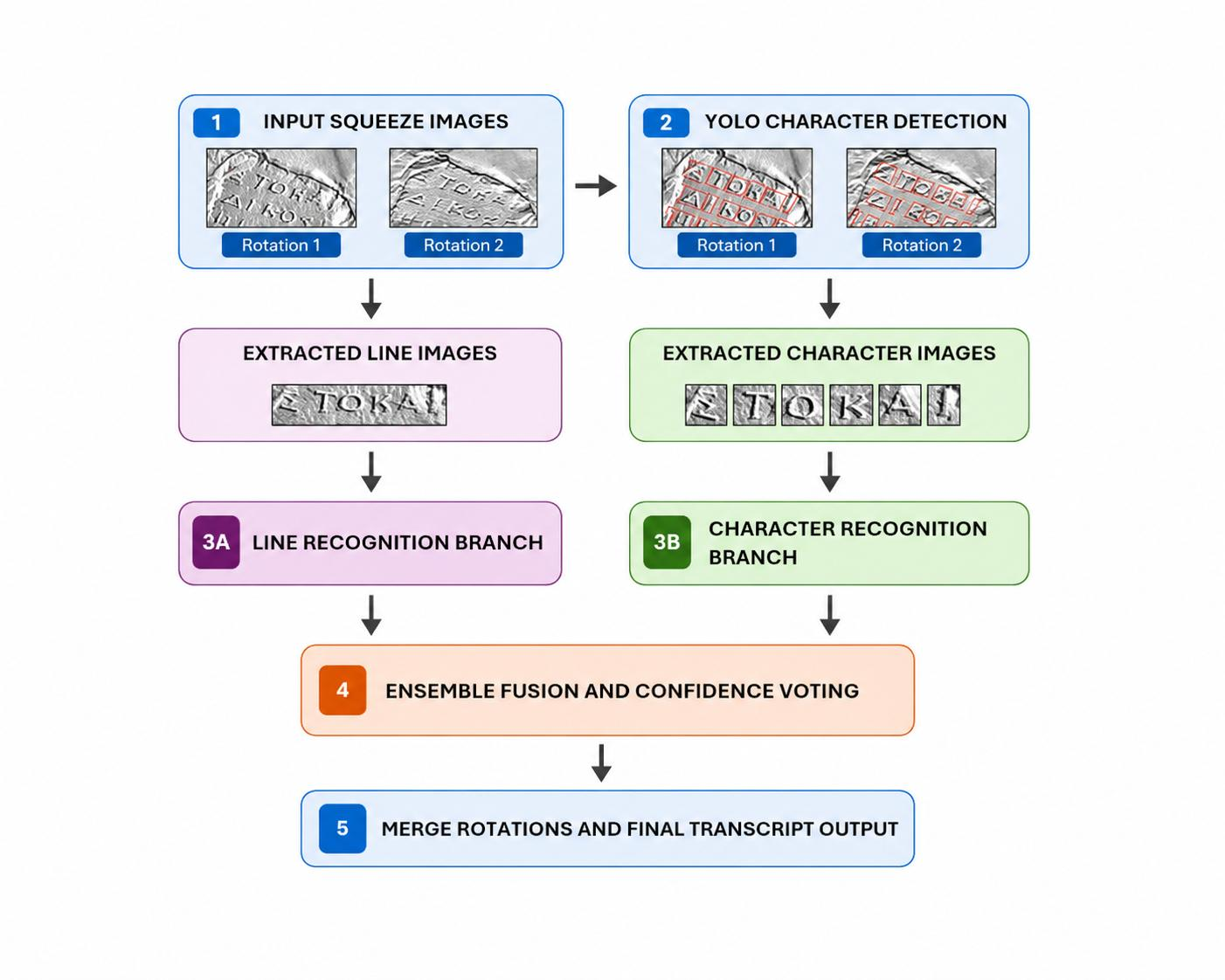
Overview of the proposed hybrid recognition pipeline. Two orthogonal views supply complementary evidence before prediction fusion and rotation merging.
YOLO11 locates characters and estimates the baseline across the squeeze surface.
ResNet18 classifies individual symbols while CNN-BiLSTM-CTC reads complete lines.
Needleman-Wunsch alignment and confidence voting reconcile the two branches.
A living space for follow-up questions, experiments, and future papers growing out of this work.
Calibrate confidence by branch accuracy so a weaker model cannot override a stronger prediction too easily.
Improve robustness to shallow relief, surface deformation, low contrast, and lighting-dependent shadows.
Target scarce and ambiguous symbols with better sampling, augmentation, and representation learning.
FULL PAPER
CITE THIS WORK
If this work supports your research, please cite the paper. This is provisional until the final proceedings metadata and DOI are available.
@inproceedings{chavan2026hybrid,
  title     = {A Hybrid Deep Learning Pipeline for Text
               Recognition on Greek Squeezes},
  author    = {Chavan, Monika Radhakisan and
               Patil, Pratiksha Manik and
               Mathews, Vineetha Mulamoottil and
               Gorges, Thomas and van der Loop, Janne and
               Christlein, Vincent},
  booktitle = {International Conference on Document
               Analysis and Recognition (ICDAR)},
  year      = {2026}
}